
A Global Capability Centre (GCC) is a wholly owned offshore unit that supports core and strategic operations for global enterprises. Unlike traditional outsourcing, GCCs allow direct control, ensuring alignment with enterprise goals and standards. India has emerged as the premier destination for GCCs, housing over 53% of the global GCC footprint as of 2024, with approximately 1,700 centres nationwide. This page outlines five strategic advantages of establishing a GCC in India.
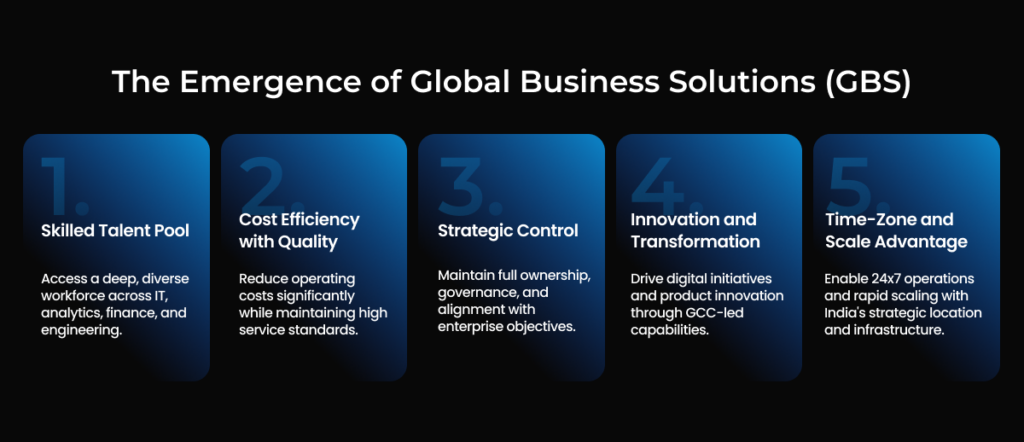
1. Access to Skilled and Scalable Talent Pool
India offers a deep and diverse talent pool, particularly across sectors like IT, engineering, analytics, finance, and digital technologies. As of 2025, more than 480 mid-market GCCs in India employ over 210,000 professionals. Furthermore, just 5% of Indian GCCs (88 mega – centres) house nearly 50% of the total GCC workforce, indicating their operational scale.
Indian professionals are globally recognised for their technical proficiency, strong communication skills, , and adaptability to multinational work cultures, making India a dependable hub for high-quality offshore delivery.
2. Strategic Cost Efficiency Coupled with Scale & Quality
Operating a GCC in India delivers substantial cost advantages in Western markets. However, the value extends beyond labour arbitrage. Indian GCCs often deliver enhanced operational outcomes by integrating automation, process excellence, and digital capabilities.
These savings empower global firms to reinvest in R&D, digital transformation, and strategic growth. As of 2024, India’s GCC sector generated approximately USD 64.6 billion in revenue, with projections estimating this figure could exceed USD 100 billion by 2030.
3. Ownership, Control and Strategic Oversight
A key distinction between GCCs and third_party BPOs lies in ownership. A GCC provides full control over operations, ensuring seamless governance, adherence to corporate standards, and robust protection of intellectual property.
This control is particularly critical for companies operating in regulated sectors such as BFSI, healthcare, and technology. Enterprises benefit from direct visibility into processes, KPIs, and compliance frameworks, which support risk mitigation and continuous performance optimisation.
4. Innovation, Digital Transformation and Higher-Value Mandates
Modern GCCs in India are no longer confined to transactional support. Many serve as strategic innovation hubs, or Centres of Excellence (CoEs), driving advanced digital initiatives. 83% of Indian GCCs are actively investing in generative AI and other transformative technologies, while 58% have begun implementing agentic AI capabilities.
This evolution reflects a shift from cost-based outsourcing to capability-based global delivery models, positioning Indian GCCs as integral to enterprise-wide innovation roadmaps.
5. Global Scale and Time-Zone Advantage
India’s time zone (GMT +5:30) enables seamless 24×7 operations, aligning effectively with both APAC and Western markets. Enterprises implementing “follow-the-sun” delivery models benefit from shorter development cycles and enhanced customer support capabilities.
India’s well-established infrastructure, favourable government policies, and proven IT ecosystem further reinforce its position as the leading offshore development centre. By 2030, India’s GCC count is projected to exceed 2,400, reflecting its robust growth trajectory.
Why India Is the Global Hub for GCCs
India is the world’s top destination for setting up GCCs due to:
· A workforce skilled in digital, analytical, and domain-specific functions
· Competitive operating costs and scalable delivery models
· Supportive regulatory environment and pro-business policies
· Strong ecosystem comprising tech parks, CoEs, and academic institutions
These advantages have enabled India to evolve from a BPO destination into a strategic nucleus for global capability and innovation delivery.
How IMS GBS Powers Successful GCC Setups in India
IMS GBS enables global organisations to establish and scale GCCs in India with unmatched speed and precision. The team offers:
· End-to-end advisory for GCC setup and regulatory compliance
· Talent acquisition strategies tailored to enterprise needs
· Infrastructure support for site selection, setup, and operations
· Process design aligned with global governance and performance metrics
With deep domain expertise and operational maturity, IMS GBS is a trusted partner for creating agile, high-performing GCCs that deliver long-term value.
Conclusion
A unique combination of scale, skill, and strategic value drives India’s leadership in the global GCC landscape. For global enterprises seeking innovation, operational resilience, and competitive advantage, setting up a Global Capability Centre in India offers a high-impact, future-ready solution. With partners like IMS GBS, businesses can unlock the full potential of India’s GCC ecosystem while ensuring compliance, performance, and continuous growth.
Frequently Asked Questions (FAQs)
What is the difference between a GCC and a BPO?
A GCC is an internal, fully owned offshore unit that provides strategic control and alignment. A BPO is a third-party provider focused on cost and transactional efficiency.
How is a captive centre different from a shared services centre?
A captive centre (GCC) is dedicated to a single enterprise, whereas a shared services centre may support multiple business units within the same organisation.
What functions are best suited to a GCC in India?
IT services, software development, data analytics, finance and accounting, procurement, HR, and product engineering are commonly operated from Indian GCCs.
Why are GCCs in India growing so rapidly?
A combination of talent availability, digital readiness, cost advantage, and a mature operating environment has accelerated GCC growth.
What is the typical setup timeline for a GCC in India?
With the right partner, enterprises can set up a GCC within 3 to 6 months, depending on scope, location, and regulatory considerations.