
Global enterprises are under pressure to modernise platforms, ship digital products faster, and strengthen operational resilience, while maintaining tight security and governance. India has become a practical solution to those requirements, as the GCC model has evolved beyond back-office support into core, value-creating work.
A survey reports that India hosts 1,700+ GCCs employing 19 lakh+ professionals, making it the largest global hub for captive centres. It also cites GCC revenue of USD 64.6 billion (FY24 estimate) and highlights a shift toward higher-value, complex technology work within the IT-ITeS sector.
What is GCC?
A GCC is typically owned and governed by the enterprise, with direct accountability for outcomes, capability maturity, and risk controls. In practice, the scope ranges from shared services to product engineering, data and analytics, cybersecurity operations, and AI-led digital delivery.
What the Economic Survey 2025–26 Signals About GCCs
The survey positions GCC growth as a structural feature of India’s IT-ITeS performance. It highlights the ecosystem’s expansion in revenue, headcount, and number of centres, citing a 9.8 per cent revenue CAGR (FY19 to FY24 estimate) and sustained headcount growth.
It also signals a shift in enterprise expectations. GCCs are increasingly embedded in global value chains as a “resilient source of growth”, with work moving into higher-value activities and innovation-led mandates. The Survey links ecosystem diversification to specialised, innovation-focused mid-market GCCs, and to expansion into Tier 2 and Tier 3 cities that strengthen local innovation and startup linkages.
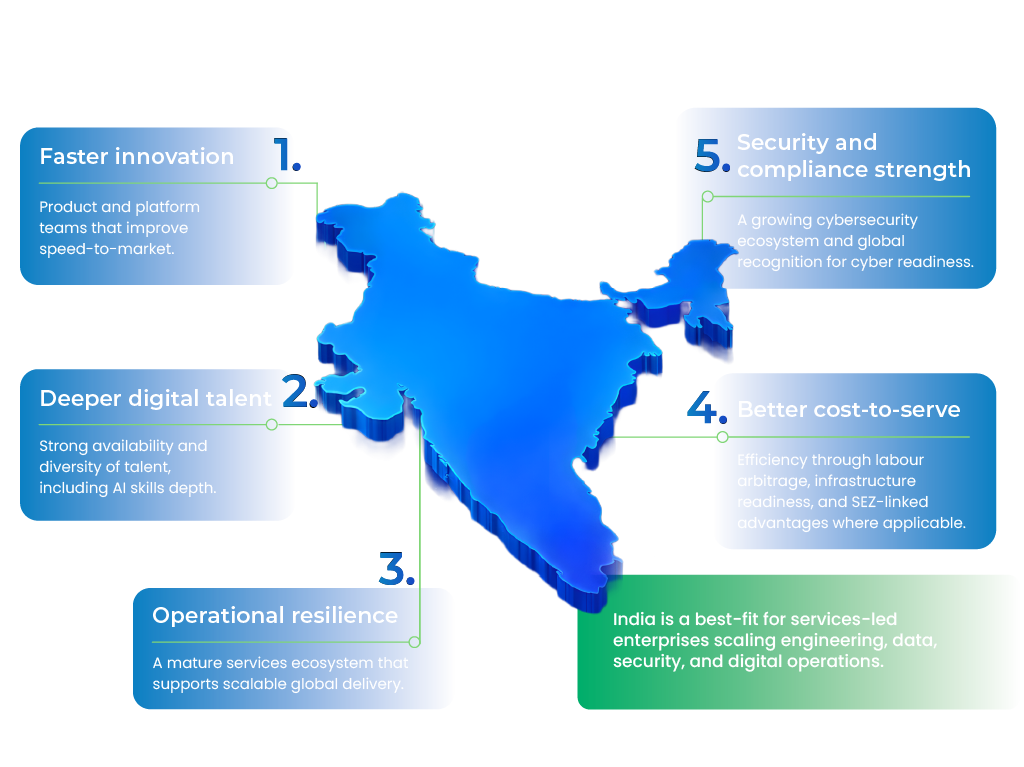
Benefit 1: Faster innovation and product delivery
Enterprises that treat GCCs as product and platform centres, generally see improvements in speed and predictability. The Survey’s description of GCCs performing product development and engineering supports the reality that these teams can own roadmaps, not only execute tasks.
For global enterprises, faster delivery is usually enabled by:
- Persistent product teams aligned to business domains
- Platform engineering that reduces duplicated build across geographies
- Cloud and data foundations that shorten release cycles
- Engineering standards and automated quality that reduce rework
This is where global capability centre benefits become measurable. Cycle time, release frequency, defect escape rate, and cost per feature are common metrics used to demonstrate value to senior stakeholders.
Benefit 2: Talent depth for digital, Ddata, and AI
GCC performance is constrained by talent density and leadership depth. The Survey attributes GCC growth to drivers such as talent availability and diversity –, underscoring why enterprises continue to expand their India delivery across technology and business services.
The Stanford AI Index, places India second globally in AI skill penetration (2.5), narrowly behind the US (2.6). This matters for enterprises building applied AI, ML Ops, data engineering, and security engineering at scale.
A GCC talent strategy that tends to perform well includes:
- Critical role definition for platform, data, security, and product leadership
- Career pathways to reduce attrition in niche skills
- Strong engineering management and architecture governance
- Structured reskilling aligned to technology roadmap
Benefit 3: Resilience for global operations and services exports
Enterprise resilience increasingly depends on reliable global services delivery, not only infrastructure redundancy. The Survey reports services exports of USD 387.5 billion in FY25 and a services trade surplus of USD 188.8 billion, reinforcing India’s position as a global hub for technology, business, and professional services.
It also notes that software, BPM, consulting, and fintech resilience are supported by India’s success as a GCC hub, with GCCs growing at a 7 per cent CAGR from FY20 to FY25.
For enterprises, this ecosystem strength typically translates into better continuity options, deeper partner networks, and faster scalability when demand fluctuates. A well-designed GCC footprint can support multi-site delivery, standardised governance, and operational resilience for customer-facing services.
Benefit 4: Cost competitiveness with capability uplift
Cost alone is not the winning argument for enterprise decision-makers. The more defensible case is cost-to-serve improvement driven by capability, automation, and governance.
The survey cites factors that bolster efficiency and competitiveness, including strong physical and digital infrastructure, labour arbitrage, and SEZ-based GCCs benefiting from tax holidays.
Enterprises can strengthen ROI by:
- Prioritising captive ownership for core IP and differentiating capabilities
- Standardising platforms and tooling to reduce engineering overhead
- Using automation in testing, observability, and security monitoring
- Building a service catalogue aligned to business outcomes and SLAs
This is also where “global capability centres” deliver compounding value, because capability investments remain inside the enterprise operating model and improve across multiple programmes.
Benefit 5: Security, compliance, and managed risk
Security and compliance are increasingly delivered as specialised services within GCCs, including threat detection, risk management, compliance operations, and managed security services. The Survey estimates India’s cybersecurity market at about USD 6.0 billion in 2023, growing at about 30 per cent, and cites India’s Tier-1 ranking on the ITU Global Cybersecurity Index 2024 with a score of 98.49.
For global enterprises, GCC-based security capability commonly includes:
- SOC and incident response operations
- Secure software development lifecycle enablement
- GRC operations with continuous control monitoring
- Cloud security posture and identity governance
Infrastructure planning also matters for digital services. The Survey notes that India’s data centre capacity is projected to reach about 8 GW by 2030, up from about 1.4 GW as of Q2 2025, and highlights the need to address constraints, including energy shortages.
Conclusion
India’s GCC ecosystem has reached a scale that is difficult to ignore. More importantly, the Economic Survey 2025–26 underscores that GCCs now deliver core activities, including product development, operations, and AI-enabled digital functions.
For global enterprises, the case for global capability centres in India is strongest when the model is designed around a single unit and supported by robust security and talent systems. The next step is an operating model that converts scale into sustained performance.
Frequently Asked Questions (FAQs)
What is GCC, and what is the full form of GCC?
GCCs ,also known as Global Capability Centres, are offshore units established to deliver technology development, engineering, analytics, and business operations for global activities.
What is the difference between GCC and outsourcing?
GCC refers to enterprise-owned delivery with direct governance and accountability. Outsourcing is delivered by a third-party vendor under a commercial contract.
What are global capability centre services typically delivered from India?
Common services include product engineering, analytics, cybersecurity operations, and AI-enabled digital functions, alongside business operations where relevant.
What are the key global capability centre benefits for enterprise leaders?
The main benefits typically include faster product delivery, access to deep digital talent, resilient services delivery, improved cost-to-serve, and stronger security and compliance outcomes.
What is a practical global capability centre definition for procurement and governance teams?
A global capability centre definition that works operationally is an enterprise-governed offshore unit with a defined service catalogue, security controls, and outcome-based KPIs.