
Global Capability Centres in India are undergoing a strategic transformation. While Tier-1 cities such as Bengaluru, Hyderabad, etc., have traditionally led this space, Tier-2 cities are emerging as high-value hubs, offering cost efficiency, a stable talent pipeline, and lower attrition. For enterprises looking to establish or expand their GCC footprint, shifting to a Tier-2 location is no longer a trend; t is a competitive advantage.
Tier-2 Cities: The New Growth Frontier for GCCs
According to recent industry reports, India is home to over 1,700 GCCs, employing nearly 1.5 million professionals. Yet only a small fraction, less than 10% are currently based in Tier-2 cities. This rapidly changes as business leaders seek operational agility, decentralised workforce strategies, and lower operating costs.
Cities such as Ahmedabad, Coimbatore, Kochi, Indore, Jaipur, and Vadodara are emerging as strong contenders, thanks to a combination of infrastructure investments, growing academic ecosystems, and evolving government policies. Why Tier-2 Cities Now Make Strategic Sense
1. Cost Advantages of Tier-2 Locations
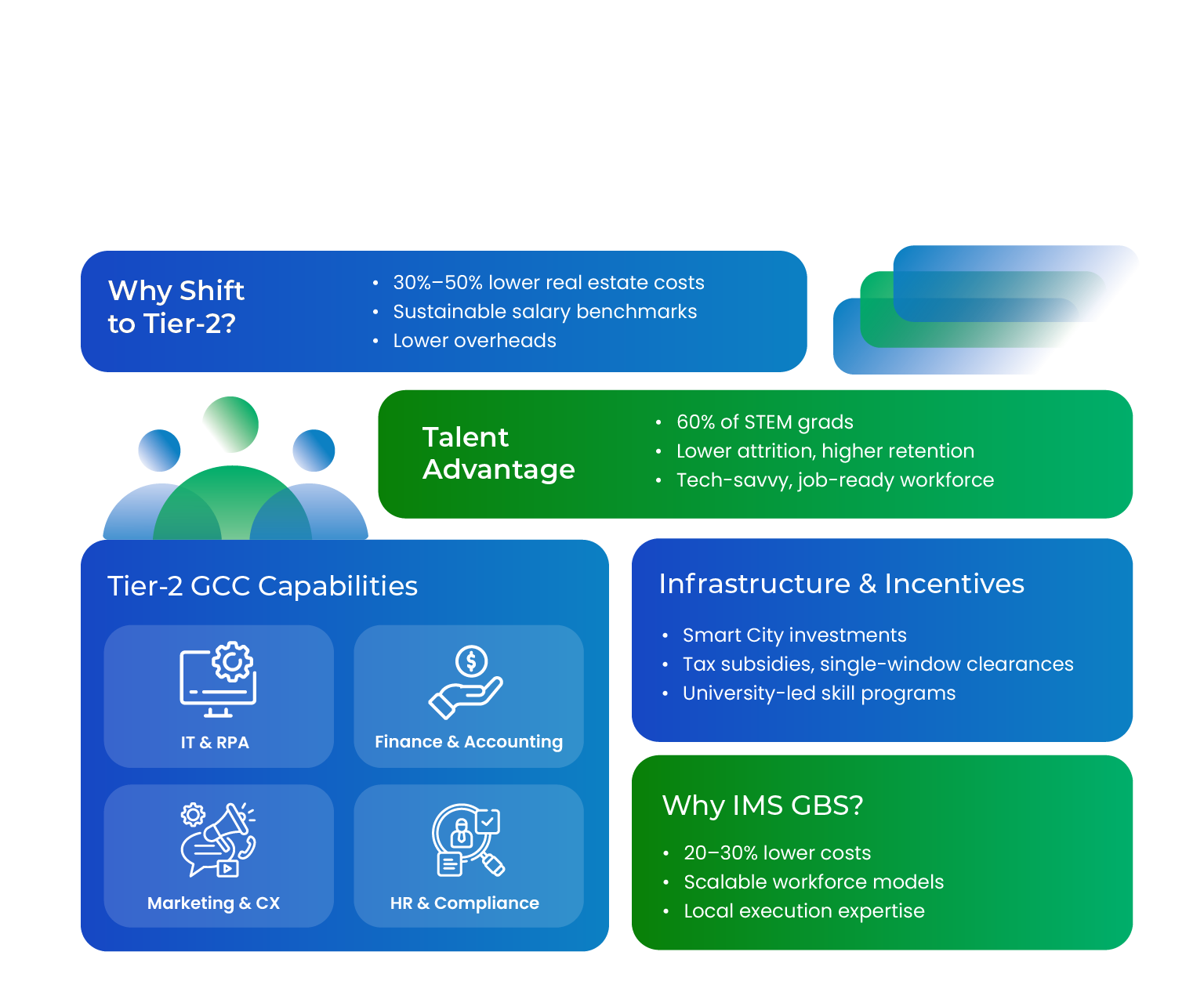
Operating a GCC in a Tier-2 city offers significant cost savings across:
- Real estate: Rentals are 30%–50% lower than Tier-1 counterparts.
- Wages: Entry-to-mid-level salaries are more sustainable without compromising on quality.
- Overheads: Utility, compliance, and administrative costs are comparatively leaner.
As GCCs are under pressure to do more with less, these cost differentials provide a scalable edge.
2. Access to a Growing Talent Pool
Tier-2 cities contribute significantly to India’s engineering and business graduate pipeline. With over 60% of STEM graduates emerging from non-metro areas, the talent pool in Tier-2 cities in India is increasingly skilled, tech-savvy, and adaptable.
Moreover, these cities report lower attrition rates and higher employee retention, making long-term workforce management in India more predictable and cost-effective.
3. Improved Infrastructure and Policy Incentives
Governments are actively supporting GCC decentralisation:
- Smart City investments are improving urban mobility, internet connectivity, and utility reliability.
- States are rolling out single-window clearance systems, tax subsidies, and ready-to-occupy IT zones.
- Talent development schemes, in partnership with local universities, are bridging the skill gap.
This policy ecosystem is creating a fertile ground for high-functioning back-office business operations beyond metros.
Expanding Scope: From Back-Office to Business Innovation
Initially designed for transactional support, GCCs in Tier-2 cities are increasingly evolving into centres of excellence for:
Finance & Accounting
Business Process Management
Marketing
Information Technology
Human Resources
Compliance & Due Diligence
Market Research & Consulting
Customer Experience (CX) Excellence
Robotic Process Automation (RPA)
With the support of managed service providers in India, global enterprises can fast-track operational set-up, access niche capabilities, and de-risk large investments.
Considerations Before Expanding into Tier-2 Cities
While the opportunity is substantial, successful GCC deployment requires informed planning. Key factors to evaluate include:
| Criteria | Consideration |
| Talent Density | Evaluate the availability of relevant skills; consider upskilling partnerships. |
| Infrastructure Readiness | Audit real estate, internet speed, power reliability, and transport. |
| Regulatory Compliance | Assess local laws, tax norms, and labour regulations. |
| Vendor Ecosystem | Identify managed service providers and HR partners to support scale. |
| Cultural Integration | Plan for orientation and engagement programs tailored to Tier-2 talent. |
The Path Ahead: Future of GCCs in India
The future of GCCs in India is hybrid and distributed. As Tier-1 cities reach saturation, Tier-2 cities are becoming foundational to cost-effective scaling, risk diversification, and access to untapped talent. The next generation of GCCs will no longer be measured solely by cost-saving metrics; they will be strategic enablers of business resilience and innovation.
IMS GBS: Your Partner for GCC Expansion in Tier-2 Cities
IMS GBS enables global enterprises to establish, scale, and optimise Global Capability Centres in India, particularly in emerging Tier-2 hubs.
By combining cost-performance models, talent intelligence frameworks, and end-to-end managed services, IMS GBS helps businesses:
- Approximately 20%–30% lower operational costs compared to Tier-1 locations
- Enhanced workforce stability through targeted workforce management solutions
- Faster scalability via managed service partnerships and local expertise
- Policy navigation support to maximise government incentives and ease compliance
With deep localisation knowledge and proven execution frameworks, IMS GBS ensures that GCCs in Tier-2 cities deliver long-term business value.
Capitalise on Tier-2 Opportunities Before the Market Saturates.