
The enterprise operations landscape is entering a high-performance era where people and AI combine to accelerate outcomes. Across sectors, companies are shifting from static, transactional models to intelligent delivery frameworks powered by outsourced staffing and AI-enabled offshore teams. This shift expands human potential – merging precision, adaptability, and speed with advanced machine intelligence to drive measurable business value. At the centre of this evolution is the strategic integration of AI outsourcing into global operations, especially in back-office functions where scale and agility matter most.
The Rise of People + AI in Operations
In recent years, the model of global business services (GBS) has shifted dramatically. 98% of GBS organisations have deployed generative AI or will be in pilot programs within the next 12 months. Also, 62% plan to implement enterprise-wide global or hybrid GBS programs within two years. These data points underscore how operations are being re-imagined: from siloed centres of cost to integrated platforms of value, driven by talent + technology.
The shift to People + AI drives three major operational changes:
1. End-to-end orchestration: Centralised or hybrid models that combine human teams with AI workflows, enabling faster decision-making and more consistent outcomes.
2. Talent plus automation: The rise of AI-enabled offshore teams or AI outsourcing models where offshore talent is augmented by machine intelligence, not replaced.
3. Outcome-orientation: Beyond cost arbitrage, the focus moves to business impact – speed, quality, forecasting, customer experience. In short, instead of “people vs machines”, operations are “people and machines”.
The Evolution of Outsource Staffing in the Age of Artificial Intelligence
Traditionally, outsourced staffing (or outsourced staffing solutions) addressed transactional, well-defined tasks, data entry, shared services, and large-volume back-office work – often handled in lower-cost locations. The emphasis was on labour arbitrage and process standardisation.
Today, the model is transforming on several fronts:
· Broader scope: Service delivery is shifting from back-office only to more strategic capabilities – analytics, digital services, compliance, and knowledge work.
· Hybrid delivery: Organisations now deploy a mix of captive centres, offshore teams and service providers, combining on-shore, near-shore, offshore, along with other digital platforms.
· Intelligent operations: The addition of AI, automation and machine learning means that staffing is less about manual tasks and more about “what humans plus machines should do together”.
· Outcome-driven contracts: Outsourcing deals no longer focus purely on headcount or FTEs. They focus on business metrics – time–to–insight, error rates, process cycle time, and customer satisfaction.
Hence, outsourced staffing is about building smart, flexible teams where human skills, offshore cost advantages, and AI-driven productivity converge.
How AI Is Empowering Global Outsource Talent in Back-Office Operations
Consider how the People + AI model plays out in back-office operations when applied to offshore teams:
· AI-augmented workflows: Routine tasks such as invoice processing, payroll reconciliation, or compliance checks can be handled by automation or bots. Simultaneously, the team members can focus on exception handling, judgment calls, and stakeholder interaction.
· Talent elevation: Offshore teams evolve from purely execution roles into roles requiring digital literacy, problem-solving, and analytics.
· Scalability and adaptability: AI enables rapid scaling of operations (via automation) while offshore staffing provides the flexible human capacity.
· Global talent pool with digital enablement: Offshore teams located in cost-efficient geographies can now be equipped with AI tools, dashboards, and remote collaboration platforms.
· Continuous improvement: The feedback loop between AI analytics, human insights, and process optimisation allows offshore teams to evolve their operations continuously.
Organisations that adopt this model are shifting from “outsourced staffing as cost arbitrage” to “outsourced staffing as strategic capability empowered by AI”.
Key Benefits for Enterprises with People + AI Collaboration
Implementing a People + AI strategy via outsourced staffing delivers a range of benefits:
· Improved productivity: Automation handles routine volumes; humans handle value tasks.
· Cost efficiency with value generation: Offshore staffing retains a cost advantage, but when layered with AI, the model begins to generate strategic value.
· Enhanced agility and responsiveness: With AI-enabled offshore teams, enterprises can respond faster to changes in volume, regulation, and business models.
· Better talent deployment: Humans can focus on judgment, analysis, and user experience rather than repetitive tasks.
· Data-driven insights: With AI in the loop, offshore staffing becomes more than a “delivery engine” – it becomes a data source for forecasting and planning.
· Global scale, local expertise: Operating across geographies, offshore teams benefit from cost zones; AI provides standardisation and control.
The People + AI Staffing Approach: Transforming Enterprise Operations at Scale
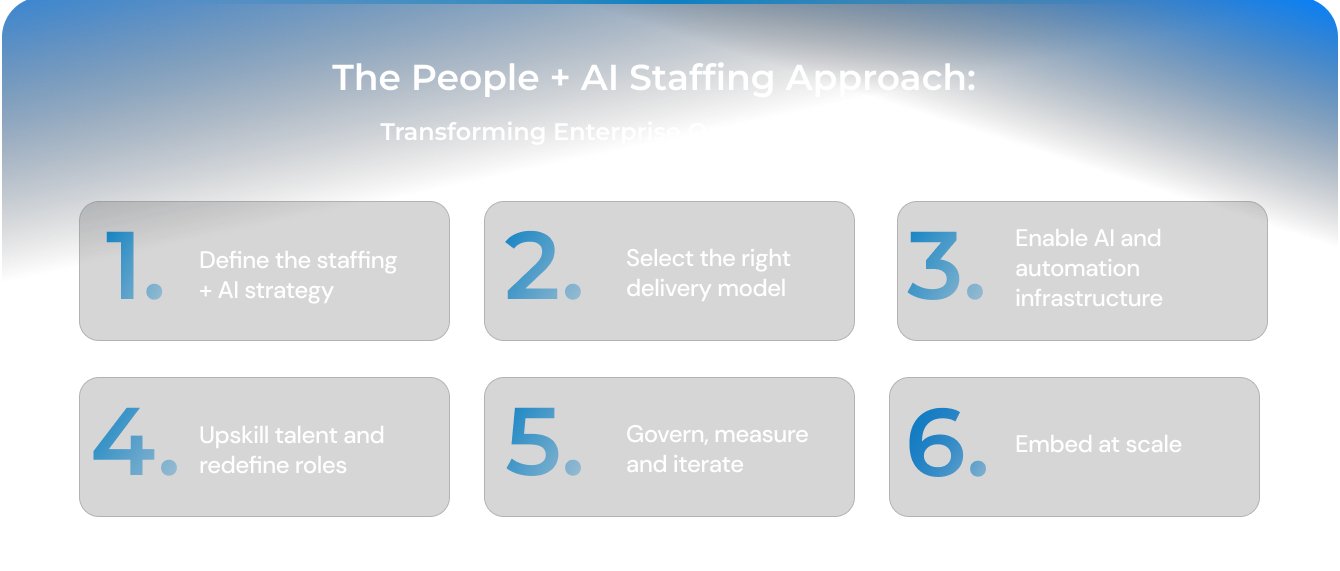
To harness the People + AI model effectively, enterprises should follow a structured approach:
1. Define the staffing + AI strategy
Identify which functions are candidates for outsourced staffing solutions and which can benefit from AI automation in offshore operations.
2. Select the right delivery model
Choose partners that support AI-enabled offshore teams, not just traditional FTE hires.
3. Enable AI and automation infrastructure
Deploy AI outsourcing tools, digital dashboards, performance analytics, and remote collaboration platforms.
4. Upskill talent and redefine roles
Ensure continuous upskilling in digital skills, analytics, and AI collaboration.
5. Govern, measure and iterate
Implement strong governance for AI-human interaction, data quality, ethics, and feedback loops.
6. Embed at scale
Standardise best practices and roll out successful models across the enterprise.
IMS GBS: Enabling Enterprise Success through People + AI Staffing Models
At IMS GBS, the goal is to help enterprises integrate AI into every layer of their outsourced staffing operations. Through purpose-built AI-enabled offshore teams, clients achieve better throughput, agility and transformation outcomes. This future-focused model positions outsourced staffing solutions not as a workaround, but as a growth multiplier.
Conclusion
The convergence of outsourced staffing, offshore teams and AI automation in operations is reshaping the back office as a centre of strategic value. Enterprises that embrace AI outsourcing today are not only gaining cost benefits but also future-proofing operations with intelligent capabilities. With IMS GBS, this model is already delivering impact at scale.