
Imagine managing business operations in the early 2000s – fragmented systems, siloed departments, and rising operational costs. To combat these inefficiencies, over 80% of Fortune 500 companies turned to Shared Service Centres (SSCs) to streamline and centralise back-office functions such as finance, HR, and IT support.
These SSCs were designed for one purpose: cost containment. By consolidating transactional tasks into a single delivery hub, organisations gained cost advantages through labour arbitrage, process efficiency, and standardised service delivery.
The traditional shared service operating model was highly transactional, with value measured in terms of cost per transaction rather than business outcomes. This left SSCs functionally efficient but strategically isolated – viewed largely as administrative cost centres rather than enablers of enterprise value.
The Traditional Role of Shared Service Centres
Historically, Shared Service Centres were designed to consolidate and standardise back-office functions such as Finance, HR, IT, and Procurement. Their core mission focused on:
· Reducing operational costs through labour arbitrage and consolidation
· Increasing process efficiency and consistency
· Strengthening control and compliance
· Providing baseline transaction support
While SSCs delivered measurable benefits, their remit often remained operational rather than strategic. They were perceived as cost centres – necessary, functional, but rarely transformative.
This model served organisations well in an earlier era. However, enterprise needs have evolved. Digital maturity, customer expectations, compliance demands, and competitive pressures now require more than process consolidation. The need for agility, advanced analytics, and business partnership has accelerated the transition to Global Business Solutions.
The Emergence of Global Business Solutions (GBS)
Global Business Solutions represents the next evolution beyond traditional shared services. The shift is characterised by:
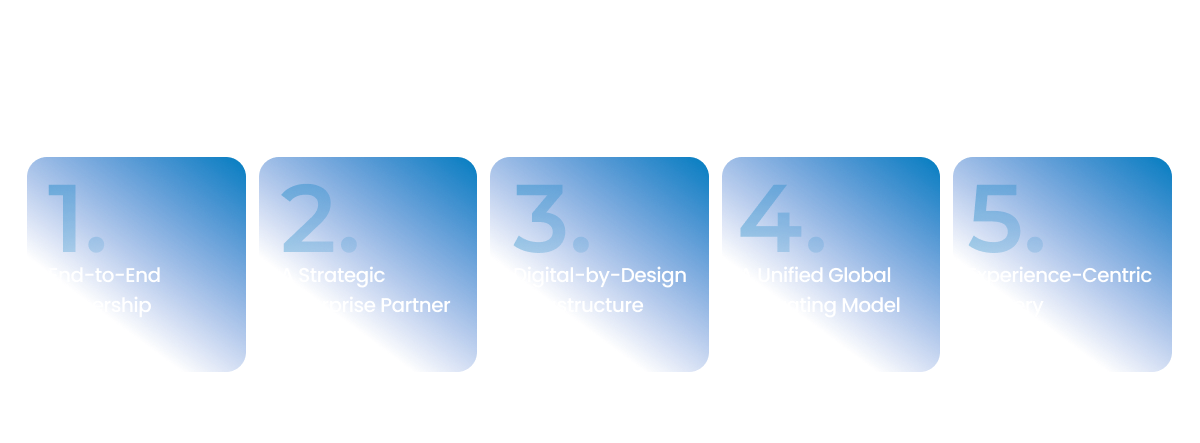
1. End-to-end ownership
GBS unifies formerly siloed functions under a single governance framework. This enables cross-functional optimisation – from Source-to-Pay and Hire-to-Retire to Record-to-Report and Lead-to-Cash.
2. A strategic enterprise partner
GBS elevates shared services from transactional execution to strategic enablement, delivering insight-led decision support, automation roadmaps, and operational resilience.
3. Digital-by-design infrastructure
Automation, AI, RPA, workflow orchestration, and cloud platforms are core components.
4. A unified global operating model
GBS builds a network of global capability centres, centres of excellence, and onshore/offshore hubs designed for agility, continuity, and scale.
5. Experience-centric delivery
GBS integrates customer experience (CX) and employee experience (EX) into its operating DNA, supporting frictionless interactions across the enterprise.
As organisations pursue resilience, standardisation, and transformation at scale, GBS has become the model of choice.
Key Global Business Solutions Trends for 2026
The GBS landscape is evolving rapidly. For 2026, several trends stand out as defining forces:
1. Hyper automation becomes the default
RPA has shifted from isolated bots to enterprise-wide automation ecosystems. AI-driven workflows, generative AI copilots, and intelligent document processing are now embedded in core functions.
2. GBS as the owner of enterprise data integrity
GBS teams increasingly manage master data governance, dashboards, analytics, and predictive insights, supporting faster, better decision-making across the organisation.
3. Expansion into complex and judgment-based activities
GBS is taking on areas traditionally handled by corporate teams, including financial planning, risk management support, CX analytics, ESG reporting, and talent intelligence.
4. Operating models emphasising agility and multi-location resilience
2026 sees increased investment in multi-country models, nearshore hubs, and centres of excellence designed for 24/7 continuity and risk diversification.
5. Experience-driven service delivery
Service catalogues are evolving to prioritise user journeys, service-level transparency, and experience-based KPIs.
6. Compliance-by-design as a strategic differentiator
Advanced regulatory frameworks – GDPR, HIPAA, SOC 2 Type 2, ISO 27001:2022, ISO 27701:2019 and Cyber Essentials – are now baseline expectations, not optional enhancements.
7. Flexible workforce models and digital talent augmentation
GBS organisations increasingly blend full-time talent, specialist augmentation, and AI-enabled digital workers into a unified workforce ecosystem.
Collectively, these trends signal a market that expects shared services to lead enterprise transformation.
The Future of Shared Services: From Cost Centres to Value Drivers
The future of shared services is built around value creation. Successful GBS functions in 2026 will be defined by:
- Strategic partnership
- GBS teams will shape transformation initiatives and influence enterprise-wide prioritisation.
- Outcome-driven delivery models
- KPIs and dashboards will focus on business impact: cycle-time reduction, working capital optimisation, compliance strength, customer experience uplift, and automation ROI.
- Scalable digital ecosystems
- Cloud platforms, low-code automation, and data-driven governance engines will underpin all service lines.
- Adaptive organisation design
- Agile pods, embedded SMEs, and cross-functional COEs will enable faster innovation and continuous improvement.
- Business resilience engineered into every layer.
- Cybersecurity, data privacy, continuity planning, and operational redundancy are embedded into the operating model.
Shared services are becoming central to enterprise competitiveness.
IMS GBS: Engineering Future-Ready Global Business Solutions
At IMS GBS, we help organisations transcend traditional Shared Service Centres and accelerate their journey toward next-generation Global Business Solutions.
Our value-driven approach integrates:
- End-to-end service ownership across Finance, HR, IT, Customer Operations, and Procurement
- Automation-first design, leveraging AI, RPA, analytics, and workflow optimisation
- Bespoke operating models tailored to your industry, compliance requirements, and global footprint
- Onshore advisory with global delivery, combining strategic insight with 24/7 operational resilience
- Transparent governance, powered by real-time dashboards, KPI frameworks, and SLA visibility
- Compliance by design, aligned with ISO 9001:2015, ISO 27001:2022, ISO 27701:2019, SOC 2 Type 2, GDPR and Cyber Essentials
Industries We Support
Technology, BFSI, Retail, Healthcare, Manufacturing, Business Services, and fast-growth scaleups.
The IMS GBS Advantage
- Boutique precision with enterprise-grade capability
- Deep domain expertise
- Flexible engagement models – including staff augmentation and managed services
- Proven acceleration of operational excellence and digital transformation
Ready to transform your shared services into a strategic value engine?
Frequently Asked Questions (FAQs)
1. What is the difference between Shared Service Centres and Global Business Solutions?
SSCs focus on transactional efficiency; GBS delivers integrated, end-to-end, cross-functional business services with strategic impact, automation, and analytics.
2. Why is GBS gaining momentum in 2026?
Organisations require enterprise agility, data integrity, compliance, and operational resilience. GBS provides the scale and governance to deliver all four.
3. Can small and mid-sized enterprises adopt a GBS model?
Yes, modern GBS models are modular and scalable, making them suitable for organisations of any size.
4. Which processes are best suited for GBS transformation?
Finance, HR, IT, Procurement, Customer Operations, Payroll, Talent Acquisition, and Data Management are typically the highest-impact starting points.
5. How does automation transform shared services?
Automation reduces manual effort, accelerates cycle times, eliminates errors, strengthens compliance, and frees teams to focus on higher-value work.
6. Why partner with IMS GBS?
We provide a precision-engineered GBS framework, advanced compliance, transparent governance, and measurable outcomes tailored for complex, high-growth environments.