
“Strategic advantage now depends on the ability to orchestrate technology, talent, and process into one integrated global capability.”
Around 50 per cent of organisations prioritising next-gen capability development already have GBS centres in India, deploying digital and data capabilities as core to their transformation. The global GCC market is projected to grow from its current size (over US$128 billion in 2023) to more than US$300 billion by 2032.
Enterprises are increasingly recognising that NextGen Global Business Services is the ideal operating model that unlocks agility, scale, and strategic differentiation. In this environment, Global Capability Centres (GCCs) anchored on next-gen GBS models become more than captive centres; they transform into true centres of excellence within the organisation.
How NextGen GBS Creates Strategic Advantage
From cost arbitrage to value creation
Traditional GCC operations focused on back-office efficiency. Next-Gen GBS integrates AI, data science, and intelligent automation to enable rapid value delivery. These hubs now function as centres of excellence, leading innovation across analytics, platform development, and customer experience transformation.
Greater strategic alignment and control
With direct C-suite integration, captive centres operating under a next-gen model achieve tighter governance, strategic visibility, and stronger cultural alignment.
Faster innovation cycles and responsiveness
By collapsing silos, Next-Gen GBS enables quicker deployment of new capabilities, experimentation with emerging technologies, and continuous improvement.
Scalable efficiency via technology leverage
Cloud platforms, low-code frameworks, and GenAI are deeply embedded within modern GCC operations, yielding exponential improvements in delivery speed and cost structures.
Talent magnet and capability incubator
Next-Gen GBS models for enterprises are designed to attract top-tier talent through exposure to high-value work, continuous learning, and innovation mandates — positioning GCCs as strategic assets.
Why India Is the Hub for GCCs and Next-Gen GBS
India continues to dominate the global GCC landscape, hosting over 50 per cent of all global captive centres. Its advantages include:
- Cost-to-value advantage: Lower TCO with improved service quality
- High-quality talent: Over 1.9 million professionals in GCCs across tech, finance, and analytics
- Ecosystem maturity: A thriving ecosystem of start-ups, universities, policy enablers and tech partners
- Innovation scalability: India leads in deploying AI/ML at scale across enterprise functions
Today, GCCs in India have evolved from back-office support units into full-fledged innovation hubs, delivering transformation at scale across global enterprises.
When Should Enterprises Consider GCCs / Next-Gen GBS Model
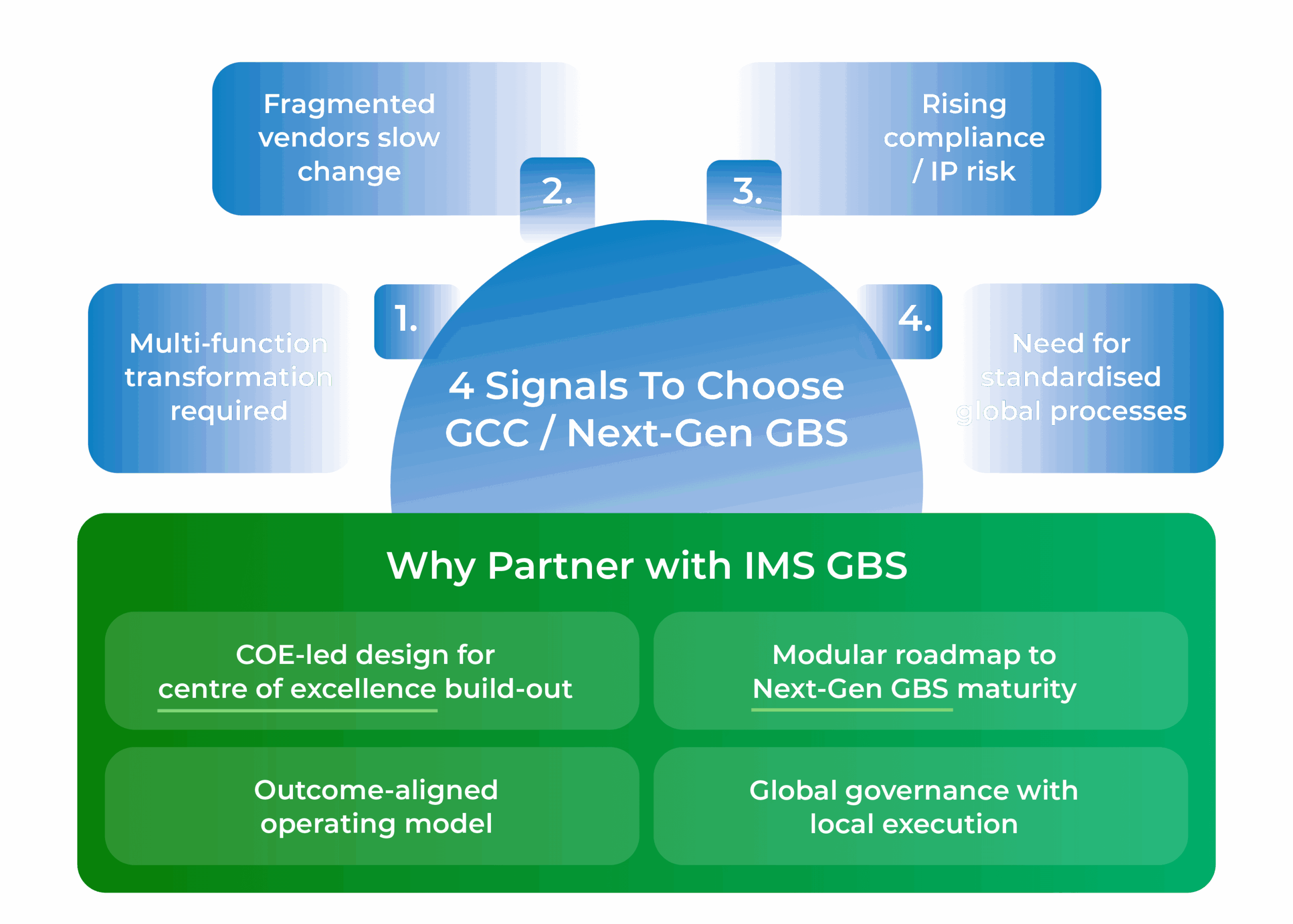
Organisations should explore the NextGen GBS path when:
- Current outsourcing models limit innovation, agility, or IP protection
- There is a need for tighter control, compliance, and domain-specific delivery
- Cross-functional capabilities (e.g. analytics + operations) are required in a unified structure
- The business seeks long-term capability development beyond cost playbooks
At this juncture, captive centres become a strategic response — delivering scalable, compliant, tech-enabled operations with long-term advantage.
Why Partner with IMS GBS for the Next Wave of GCC Transformation
IMS GBS enables enterprises to transform delivery models by building, optimising, and scaling Next-Gen Global Business Services capabilities.
Key differentiators include:
- Proven transformation of GCC operations into innovation-driven centres of excellence
- Modular frameworks that accelerate GBS maturity
- AI and analytics-led capability building within captive centres
- Focus on business outcomes, instead of just delivery SLAs
- Localised execution with global governance
IMS GBS empowers global enterprises to future-proof their operations through the GCC operations– combining speed, intelligence and control.
Contact us to unlock your next wave of transformation.